Many founders ask me the same question before committing: what does your Talent Passport support actually consist of? The question is a fair one. The French Talent Passport – Business Creation scheme unfolds over several months, each stage conditions the next, and it involves several French administrations together with one consular post abroad.
This article answers without generalities: it retraces an actual Talent Passport support engagement, from our first exchange to the company’s Kbis, the opening of its business bank account and the release of its share capital. It dwells in particular on the point that raises the most questions – the €30,000 share capital deposit and the role of the CARPA of the Paris Bar. Nor does it leave out the setbacks: an unfavourable opinion from the administration, a rejected transfer, and how each was handled.
Step 1 – Initial diagnosis and strategic scoping
It all begins with an initial thirty-minute consultation, offered free of charge, which you book online.
During this exchange, I listen to your project in detail, verify that you qualify under the Talent Passport scheme, and identify the appropriate route among the available options: creation of a new company, innovative economic project, investment in an existing French company, or takeover of an existing business. I also share my view on the corporate form suited to your project, on how to structure the financing, and a first assessment of the feasibility of your file in light of the DRIEETS requirements.
This initial diagnosis is delivered orally. A written preliminary legal opinion, structured in question-and-answer form, is available as an option for those who wish to size up their project in advance, secure their legal analysis, or obtain a detailed deliverable before engaging the file-constitution mandate.
Step 2 – Legal formation of the company
Once the mandate is confirmed, I initiate the legal formation of your future company. In most cases, the retained form is the single-shareholder simplified joint-stock company (SASU), suited to sole founders and to individual investors. I have covered this in a dedicated article on setting up a company in France as a foreign national.
I draft the full set of constitutive documents: draft articles of association tailored to the specificities of the Talent Passport, list of subscribers and statement of payments, power of attorney to the firm for the filings before the INPI single desk, and declaration of non-conviction and filiation. I apply the lawyer’s countersignature to the articles as an « acte d’avocat », which gives them a certain date, guarantees their integrity and reinforces their evidentiary weight.
At this stage, the articles remain a draft: they are attached to the DRIEETS file, then signed definitively, electronically, once the visa has been issued. The list of subscribers has a very practical consequence: it designates the person from whom the CARPA will accept the funds.
In parallel, I introduce you to a commercial domiciliation provider approved by the Prefecture, with which I negotiate a domiciliation contract in your name. I obtain the attestation that allows the opening of the CARPA file and, later, the registration of the company.
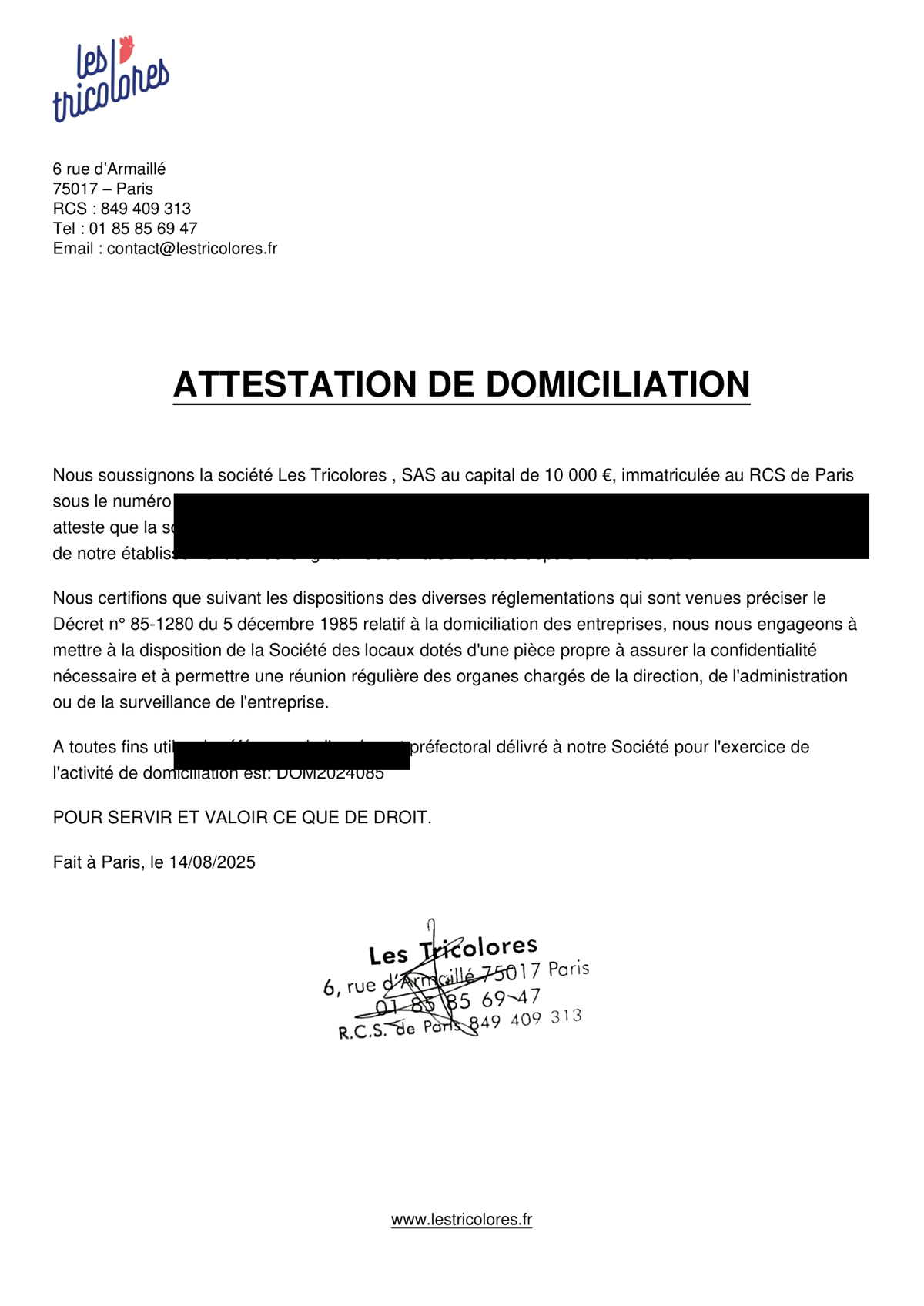
Commercial domiciliation attestation issued by an approved provider (anonymised document).
Step 3 – Securing the €30,000 through the CARPA escrow account
This is the most sensitive point of the file, and the one that generates the greatest apprehension among my clients. It deserves a clear explanation.
Why a French bank is not an option
French law requires proof of an effective deposit of €30,000 on a French account dedicated to the economic project. However, no French bank will open an account for a foreign director before they hold a residence permit. This deadlock is a classic one: it blocks the file before it even starts.
The escrow account of the CARPA of the Paris Bar
The deadlock is resolved through the escrow account of the CARPA – the Caisse autonome des règlements pécuniaires des avocats, an institution of the Bar Order, independent and strictly supervised. In practical terms, I open an escrow account in your name, dedicated to your file. You transfer the €30,000 to it from your personal account in your home country.
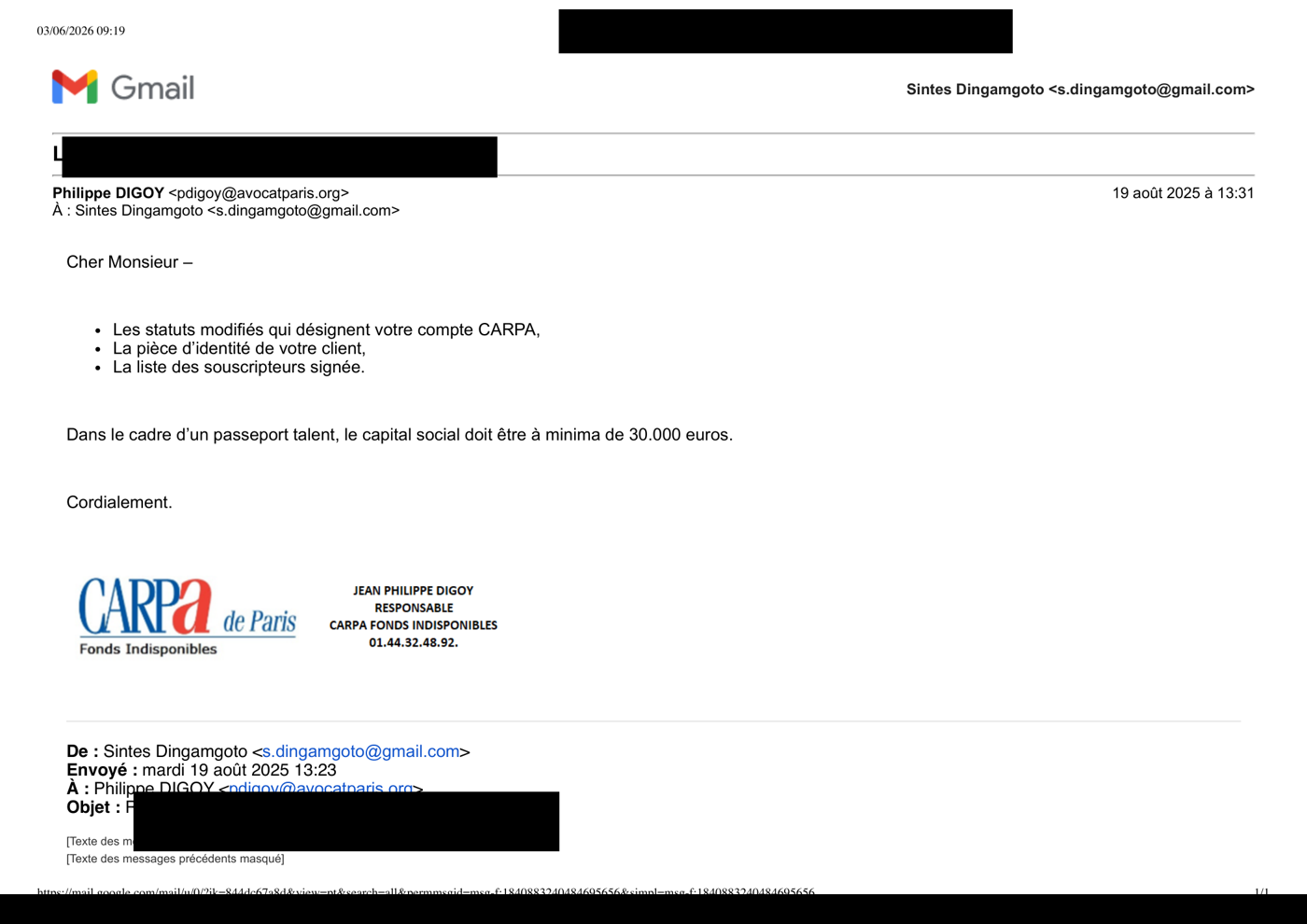
Exchange with the restricted funds department of the CARPA of the Paris Bar, at the opening of the file (anonymised document).
The CARPA account comes before the DRIEETS submission
The order of operations matters. The DRIEETS assesses the minimum investment on the basis of the documents it receives: an economic file therefore cannot be submitted until the escrow account IBAN has been obtained from the CARPA and passed on to the client so that the transfer can be ordered. Experience also shows that it is preferable to wait for the attestation of deposit itself before submitting the file, rather than announcing that it will follow. The case described below illustrates why.
The transfer must come from the shareholder’s personal account
The CARPA only accepts funds from the person designated as subscriber in the constitutive documents – that is, the founding shareholder, personally. A transfer issued by a company belonging to that same shareholder, even one wholly owned and based in their home country, is not a contribution by the shareholder within the meaning of the documents: it is refused.
This is what happened in another of the firm’s files. The funds arrived from the account of a foreign company owned by the founder, which appeared nowhere in the documentation sent to the CARPA. The restricted funds department rejected the payment on the ground that the sender was unknown to it, arranged for the funds to be returned, and reminded us that it would accept the contribution only from the subscribing shareholder in person. The result: funds to be returned, a new transfer to be ordered from the right account, and days lost.
Allow for bank charges
An international transfer rarely arrives for its original amount: the sending bank, and sometimes an intermediary bank, deduct their charges along the way. Yet the capital stated in the articles must match the sum actually received on the escrow account. I therefore recommend choosing, where the bank offers it, the option under which the sender bears all charges (the « OUR » option), adding a safety margin of a few tens of euros, and quoting in the payment reference the file reference provided by the CARPA. Any surplus is dealt with when the funds are released.
Who owns the funds
The funds remain at all times your exclusive property. They are ring-fenced, separated from the firm’s assets, and fully refundable in the event of a DRIEETS or consular refusal, the only possible costs being those of the return bank transfer.
The official attestation of deposit
Upon receipt of the funds, the CARPA of the Paris Bar issues, in its own name, the official attestation of deposit of the share capital. It is this attestation, and not a document from the firm, that has probative value vis-à-vis the French administration. It is then attached to the DRIEETS file and, later, to the consular file, and finally to the company registration file.
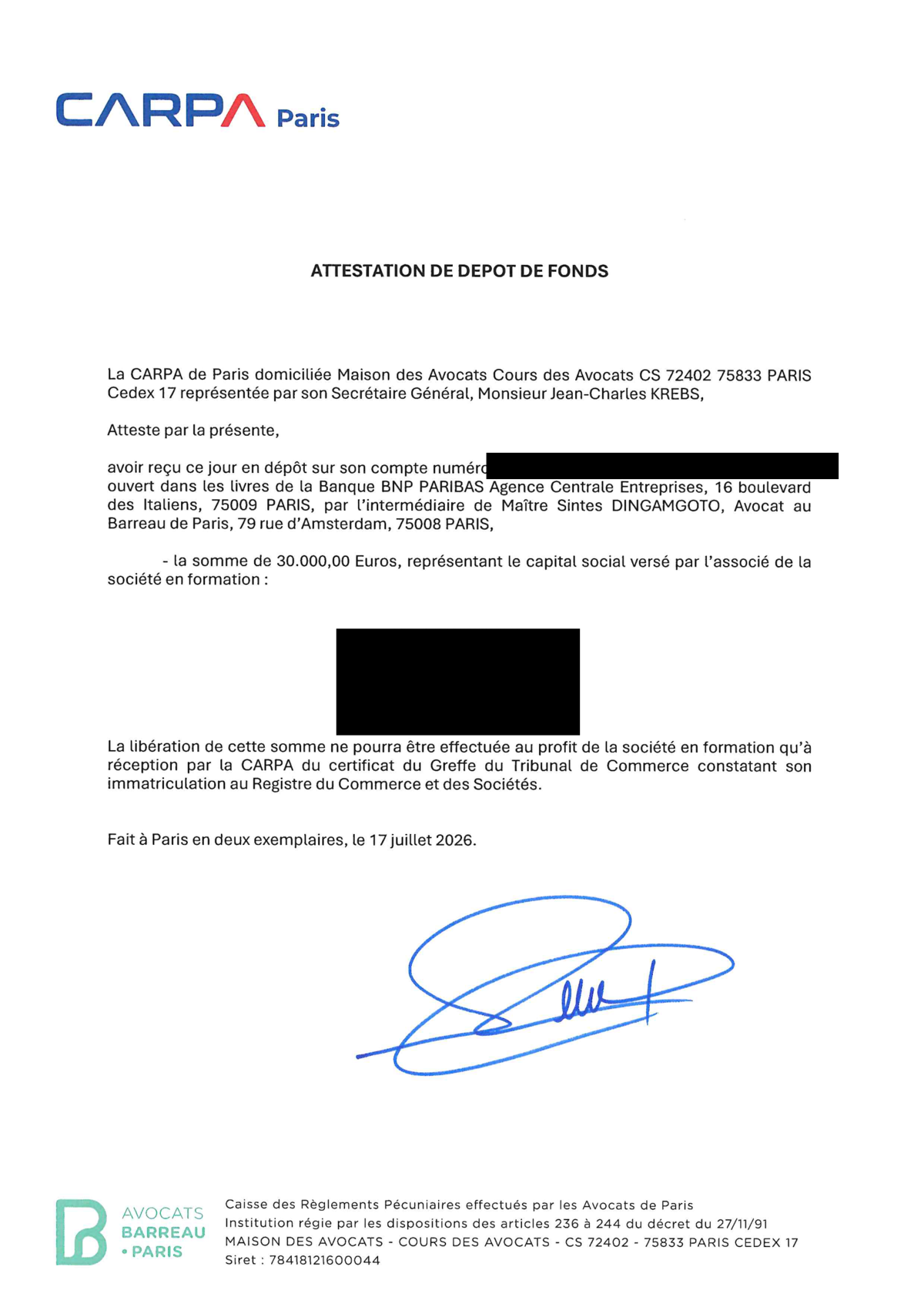
Attestation of deposit of funds issued by the CARPA of Paris for a €30,000 share capital (anonymised document).
Step 4 – Economic file and DRIEETS submission
In parallel with the legal formation and the CARPA deposit, I build the economic core of the file – precisely what the DRIEETS will scrutinise to recognise the real and serious nature of your project.
This involves the drafting of a complete and structured business plan, including market analysis, competitive positioning, description of the offering, commercial strategy and operational organisation, together with a three-year financial forecast comprising profit-and-loss statement, twelve-month monthly cash-flow plan, initial financing plan and sensitivity analysis. I also draft the presentation note on plain paper, personally signed by you, setting out your background and your project.
I then draft the submission letter to the DRIEETS of Île-de-France, documenting each requirement of the scheme piece by piece, and I compile the entire file into a single PDF organised in reading blocks for the case officer, with a navigable table of contents. I follow the exchanges with the administration through to the delivery of the attestation recognising the real and serious nature of the project – the document that unlocks every subsequent step.
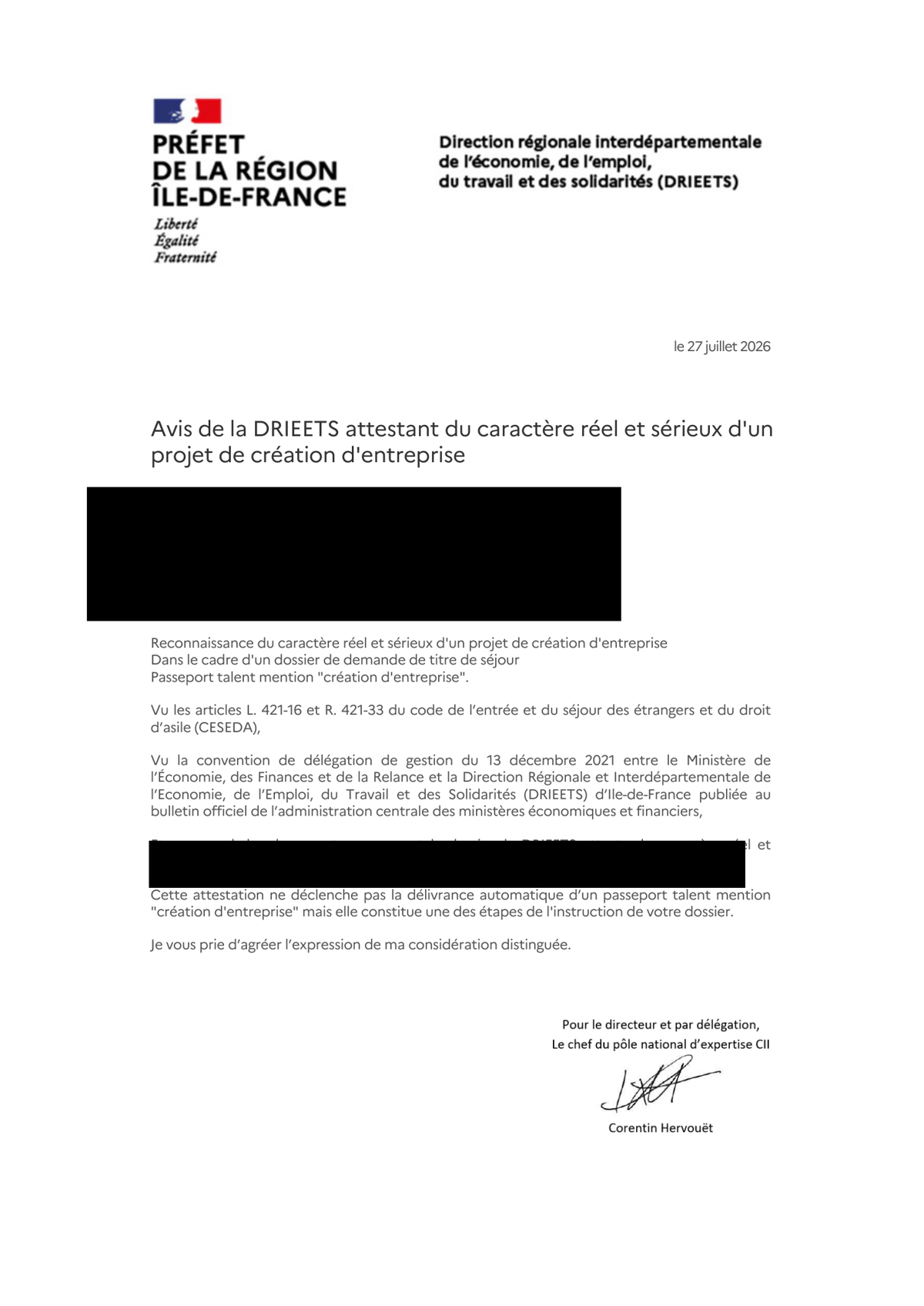
DRIEETS opinion recognising the real and serious nature of a business creation project (anonymised document).
What if the DRIEETS issues an unfavourable opinion?
An unfavourable opinion is not necessarily the end of the file. Everything depends on the ground relied on and on whether it can be cured.
In the file of a non-resident consultant specialising in outsourced finance functions, the submission had been sent with every document except the CARPA attestation, which was announced for the following two weeks. Less than two weeks after filing, the DRIEETS issued an unfavourable opinion on a single point: the minimum investment had not been evidenced. The founder’s qualifications, his resources, the real and serious nature of the project and the registered office were not disputed.
The ground could be cured. On the very day the CARPA received the funds and issued its attestation, I asked the DRIEETS to reconsider, producing the attestation and the two CARPA emails confirming receipt of the transfer. The favourable opinion was issued ten days later. The lesson is straightforward: this is why I now recommend submitting the file only once the attestation of deposit is in hand.
Step 5 – Consular formalities and installation in France
Once the DRIEETS opinion is obtained, I guide and coordinate the constitution of your consular file with the French post in your country of residence. I prepare the list of expected documents, I assist you in constituting the family file where there is an accompanying spouse or accompanying children, and I draft the letters or attestations required for your Talent Passport long-stay visa application.
The consulate issues a long-stay visa equivalent to a residence permit (VLS-TS), bearing the mention « Passeport Talent – création d’entreprise », valid for up to one year. While it is valid, its holder is exempt from applying for a residence card (Article R. 431-16 of the French Code on the Entry and Residence of Foreigners, CESEDA).
Registering the company
Once the visa is issued, I initiate the second phase of formalities. The articles are signed electronically, with my countersignature. I publish the notice of incorporation in a legal announcements journal, then file the registration with the INPI single desk: articles, domiciliation attestation, CARPA attestation of deposit, list of subscribers, declaration of non-conviction and filiation, the director’s identity document, proof of publication, and the declaration of beneficial owners. In the file described above, the court registry issued the Kbis about two weeks after the articles were signed.
The business bank account and the release of the capital
With the Kbis and the visa in hand, the director can open the company’s business bank account. In the same file, an online bank approved the account some twelve days after registration.
Before any transfer of funds to the company’s bank account, I carry out an oral verification of the bank details directly with the recipient of the transfer, in accordance with CARPA requirements. The director then signs, electronically, a written withdrawal authorisation designating the company’s account as the sole beneficiary of the funds. On that basis, the CARPA transfers the capital to the business account. This step secures the execution of the transfer and evidences compliance with the operating rules governing restricted funds.
Validating the visa and what comes next
Within three months of arriving in France, the holder validates the visa online on the French administration’s foreigners portal. It is then up to the holder to apply for the multi-year Talent Passport residence card before the visa expires.
For persons already residing in France under a long-stay title, an in-country change of status is possible in most cases, without any return to the country of origin being necessary. This lightens both the timetable and the overall budget of the project.
Step 6 – Economic completion of the project
Talent Passport support ends when your project becomes economically autonomous. You are then in possession of your validated Talent Passport long-stay visa, of the Kbis of your company, of the professional bank account opened in its name, and of the €30,000 of capital transferred from the CARPA to that final account.
Your company is operational and you are legally authorised to carry out your business activity. What was only a project when we first spoke has become an active company, a valid residence permit, available cash and a concrete economic installation in France.
Talent Passport support in practice, week by week
Here is the timeline of the file described above, counted in weeks from the preliminary consultation. It applies to that file and does not predict the timeline of another.
| Week | Stage |
|---|---|
| W0 | Written preliminary consultation, then signature of the engagement letter two days later |
| W3 | DRIEETS submission: complete file except the CARPA attestation |
| W5 | Unfavourable DRIEETS opinion, on the minimum investment only |
| W6 | Funds received by the CARPA, attestation issued, request for reconsideration the same day |
| W8 | Favourable DRIEETS opinion |
| W12 | Talent Passport long-stay visa issued, articles signed electronically |
| W14 | Legal notice published, then Kbis |
| W16 | Business bank account approved, CARPA withdrawal authorisation signed |
Some fourteen weeks thus separate the first written opinion from the Kbis. The unfavourable opinion did not lengthen this timetable, since the reconsideration was handled in ten days; it could have done, and a file submitted with its CARPA attestation in hand avoids the risk.
Actual timelines of a Talent Passport support engagement
Four blocks of timelines pace your journey.
- My part of the work: I finalise the entire file – articles of association, business plan, financial forecast, DRIEETS submission and the compiled PDF – within two to three weeks from the signing of the engagement letter, provided you have transmitted all the requested documents and made the CARPA transfer.
- The French administration’s part: the DRIEETS issues its opinion within an average timeframe of ten days to three weeks from the filing of the file.
- The consulate’s part: the long-stay visa processing time depends on the French consular post in your country of residence. It varies with the post, the time of year and the workload of the services. In the file described above, it took about four weeks.
- Installation: signing of the articles, legal notice and registration, then opening of the business account and release of the capital. Allow roughly one month, depending on the registry and the bank.
Frequently asked questions
Why go through the CARPA rather than a bank?
Because a French bank will not open an account for a foreign director without a residence permit, while the residence permit itself presupposes proof of the deposit. The CARPA escrow account lifts that deadlock, under the supervision of the Bar Order.
Can I transfer the €30,000 from my company’s account?
No. The CARPA only accepts funds from the shareholder designated in the constitutive documents, from their personal account. A transfer issued by a company, even one owned by the founder, is rejected and returned. Also allow for bank charges: the amount received must match the capital.
Is the €30,000 recoverable if the application is refused?
Yes. The funds remain your property and are separated from the firm’s assets. In the event of a DRIEETS or consular refusal, they are returned to you, the only possible costs being those of the return bank transfer.
Is an unfavourable DRIEETS opinion final?
Not necessarily. Where the ground can be cured, a request for reconsideration accompanied by the missing documents may lead to a favourable opinion. The outcome nonetheless depends on the ground relied on and on the administration’s assessment.
When does the €30,000 become available to the company?
After registration and the opening of the business bank account. The CARPA then transfers the capital to that account, on the basis of a withdrawal authorisation signed by the director and after oral verification of the bank details.
Do I have to return to my home country to file the application?
Not necessarily. If you already reside in France under a long-stay title, an in-country change of status can be considered in most cases.
What happens if my file is incomplete?
The administration may request additional documents, or even issue an unfavourable opinion, which lengthens the processing time. This is precisely why the file is compiled into a single PDF, documented requirement by requirement, and submitted once the CARPA attestation has been obtained.
Discuss your Talent Passport support
I offer an initial thirty-minute consultation, free of charge, to be booked directly online. We use it to scope the Talent Passport support suited to your situation. We review your eligibility, the route suited to your situation and the broad outline of the timetable.
Ethical notice: the illustrations reproduced in this article are drawn from actual files of the firm, anonymised and reproduced with the consent of the clients concerned, in compliance with professional secrecy. The timelines quoted are those of a specific file and are indicative only. The firm is subject to a duty of best efforts; the decision to issue the attestation, the visa or the residence permit lies with the competent administrative and consular authorities.